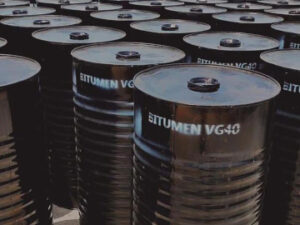
Penetration Grade Bitumen
it is a kind of bitumen classified due to its hardness and consistency which determines the degree of penetration. As the penetration increases, the bitumen becomes softer. This kind of bitumen, also known as PEN grades bitumen, is used typically for road construction & paving goals. The amount of penetration is determined via its penetration test in the laboratory using a special needle at a temperature of 25 degrees Celsius.
The most common penetration grade bitumen types are 30-40, 40-50, 60-70, 80-100, 85-100. Each of these grades is suitable for a specific condition considering various factors particularly temperature, traffic, and geotechnical features.
Having been too soft or hard, the bitumen possibility of cracking or deformation increases, hence the importance of using an appropriate choice regarding the climate condition, is obvious.
As it is somehow clear, the soft bitumen performs better in cold weather and the hard one works better in hot climates.


| Penetration Grading | Viscosity Grading | ||
| Grade | Penetration in 0.1 mm | Grade | Viscosity @60°C, Poise |
| Pen 40/50 | 40-50 | AC-40 | 4000±800 |
| Pen 60/70 | 60-70 | AC-30 | 3000±600 |
| Pen 85/100 | 85-100 | AC-20 | 2000±400 |
| Pen 120/150 | 120-150 | AC-10 | 1000±200 |
| Pen 200/300 | 200-300 | AC-5 | 500±100 |
| AC-2.5 | 250±50 | ||
Bitumen 40-50
Bitumen 40/50
Bitumen 40/50 is a relatively hard penetration-grade paving binder with a penetration range of 40–50 dmm at 25°C. Its lower penetration value indicates a firmer consistency than grades such as 60/70 and 80/100, giving the binder characteristics that are particularly valuable in asphalt pavements exposed to high temperatures, heavy wheel loads and repeated traffic stresses.
It is widely used in demanding infrastructure projects, especially in hot-climate markets, where controlling permanent deformation and maintaining pavement stability are important considerations.
Performance Under Heavy Loading
The relatively high consistency of Bitumen 40/50 contributes to the stiffness of the asphalt binder and can improve resistance to rutting and permanent deformation under repeated loading. This makes the grade particularly relevant to pavements exposed to high axle loads, elevated surface temperatures and substantial shear forces.
Bitumen 40/50 is therefore commonly considered for expressways, highways and heavily trafficked arterial roads, particularly where climatic and traffic conditions place greater demands on conventional paving binders.
As with other penetration grades, actual pavement performance depends on the complete asphalt mixture, aggregate characteristics, pavement structure, traffic conditions and climatic environment. Grade selection should consequently be based on the applicable engineering requirements rather than penetration value alone.
High-Load Infrastructure Applications
The harder consistency of 40/50 extends its use beyond conventional road paving. It is frequently considered for asphalt applications where concentrated or repetitive wheel loading requires a stable pavement structure.
Typical applications include:
Airport runways and taxiways, exposed to repeated aircraft wheel loads
Port and container terminal pavements, subject to heavy vehicles and concentrated loading
Industrial yards and logistics areas, where intensive heavy-duty traffic can cause pavement deformation
Expressways and major highways in warm and high-temperature regions
Motor racing circuits, where asphalt surfaces experience repeated loading, elevated temperatures and significant lateral forces
The grade may also be used in selected industrial and specialized applications where a harder bituminous binder is required. Its use in waterproofing membranes and similar products depends on the formulation and technical requirements of the finished material.
Production & Grade Classification
Bitumen 40/50 is manufactured from petroleum-derived feedstocks through controlled refinery processing. The grade is classified through the needle penetration test, which measures the depth of penetration into the binder under standardized conditions, including a temperature of 25°C, a specified load and a defined test period.
With a penetration range of 40–50 dmm, this grade falls within the harder range of conventional penetration-grade paving binders. Its quality is assessed through penetration together with other characteristics such as softening point, ductility, viscosity and temperature-related properties, according to the relevant product standard.
Production conditions and feedstock characteristics can vary between refineries. For this reason, the conformity of a shipment should be established through its laboratory test results and declared specification, rather than by assuming identical characteristics from the grade designation alone.
Markets & International Demand
Bitumen 40/50 has established demand in hot and heavily trafficked markets, particularly across the Middle East, South Asia and selected African countries. 40/50 is particularly prevalent in hot-climate markets and heavy-duty pavement applications.The United Arab Emirates, Kuwait, Oman, India, Pakistan, Nigeria and Ghana are among such destinations particularly for road and infrastructure projects where resistance to rutting and permanent deformation is an important consideration.
Demand and grade preferences vary between countries and individual projects, with local road authorities often specifying the required penetration, viscosity or performance grade according to pavement design and environmental conditions.
Quality Assurance & Shipment Documentation
For each supply contract, the technical requirements are established in accordance with the agreed grade and destination specification. Shipment quality can be documented through a Certificate of Analysis (COA), providing the relevant laboratory results for the cargo.
Where the transaction calls for third-party verification, SGS inspection may be arranged as part of the pre-shipment quality-control process. For regulated destinations, additional conformity procedures such as PVoC and issuance of a Certificate of Conformity (CoC) can be handled when required by local import regulations.
This approach allows the documentation package to be aligned with the actual requirements of the destination rather than applying the same certification procedure to every shipment.
Bitumen 40/50 Supply
Nexoil supplies Bitumen 40/50 for road construction, asphalt production and demanding infrastructure applications in international markets. Supply arrangements are based on the buyer’s grade, quantity, destination, applicable standard, packing requirements and inspection conditions.
For Bitumen 40/50 requirements, contact Nexoil with your destination and quantity to receive a quotation together with the relevant technical and export documentation requirements.
| Specification | Test Method | Unit | Min. | Max. |
| Specific Gravity at 25 °C | ASTM D70 | kg/m³ | 1.01 | 1.05 |
| Penetration at 25 °C, 100g, 5s | ASTM D5 | 0.1mm | 40 | 50 |
| Softening Point | ASTM D36 | °C | 52 | 60 |
| Ductility at 25 °C | ASTM D113 | Cm | 100 | – |
| Loss on Heating | ASTM D6 | %WT | – | 0.5 |
| Drop in Penetration after Heating | ASTM D5 | % | – | 20 |
| Flash Point | ASTM D92 | °C | 250 | – |
| Solubility in Trichloroethylene | ASTM D2042 | %WT | 99.5 | – |
| Spot Test | AASHTO T102 | Negative |
Bitumen 60-70
Bitumen 60/70 is a penetration-grade paving binder with a penetration range of 60–70 dmm at 25°C. Its comparatively firm consistency makes it a widely specified binder for asphalt pavements where resistance to traffic-induced deformation and adequate structural stability are important considerations.
It is extensively used in road infrastructure, from major highways and urban roads to pavement renewal and maintenance projects, and is particularly common in temperate and warm climatic zones.
Engineering Properties
The 60–70 dmm penetration range represents the consistency of the binder under standardized test conditions. In pavement engineering, penetration is considered alongside parameters such as softening point, ductility, viscosity and temperature susceptibility when assessing binder performance.
The relatively firm nature of 60/70 contributes to the stability of asphalt mixtures under repeated wheel loading. This is especially relevant where pavements are exposed to heavy traffic, high axle loads or elevated pavement temperatures, conditions in which excessive binder softness may contribute to rutting and permanent deformation.
At the same time, the binder retains the characteristics needed for effective coating of mineral aggregates and production of conventional hot mix asphalt. Final pavement performance is determined by the complete asphalt mixture, pavement structure, environmental conditions and construction practices rather than by binder penetration alone.
Road & Asphalt Applications
Bitumen 60/70 is extensively incorporated into asphalt mixtures used for:
Highways and intercity roads
Urban and municipal road networks
Base and binder courses
Wearing and surface courses
Heavy-traffic pavement structures
Road rehabilitation and resurfacing
General asphalt concrete production
The grade may also serve as a feedstock for selected polymer-modified bitumen formulations, where polymers and other formulation parameters are introduced to obtain enhanced performance characteristics for demanding pavement applications.
Manufacturing Route
Paving-grade Bitumen 60/70 is manufactured from petroleum-derived feedstocks through controlled refinery operations. In conventional production, suitable atmospheric residue is processed through vacuum distillation, producing a vacuum residue fraction that can be further processed or formulated to achieve the target paving-grade properties.
The characteristics of the feedstock and refinery configuration influence the resulting binder properties. Consequently, the production route should not be assumed solely from the penetration grade; shipment-specific laboratory results and conformity with the declared standard provide the appropriate basis for product acceptance.
Depending on the contract and destination, Bitumen 60/70 may be supplied against recognized ASTM, EN or national standards, with the relevant technical parameters documented for each shipment.
Testing, Inspection & Certification
For overseas deliveries, Nexoil places particular emphasis on verifiable product quality and destination-specific documentation.
Each shipment can be supported by a Certificate of Analysis (COA) presenting the laboratory results for the supplied cargo against the agreed technical parameters. Where independent inspection is requested, SGS inspection can be arranged in accordance with the terms agreed with the buyer.
Certain import markets require additional conformity procedures before cargo departure. Where Pre-Export Verification of Conformity (PVoC) applies, Nexoil can coordinate the required inspection and verification process, including the issuance of a Certificate of Conformity (CoC) where mandated by the destination authority.
The documentation package is determined by the destination country’s import regulations, the contractual terms and the applicable product standard. These requirements are established before shipment to ensure that the cargo documentation corresponds with the intended market.
Bitumen 60/70 for International Projects
With its established position as a conventional paving grade, Bitumen 60/70 is traded extensively for infrastructure and asphalt projects across Africa, Asia and other developing road markets.
Nexoil handles supply according to the technical and logistical parameters of each transaction, including grade, standard, quantity, packing, inspection requirements and destination documentation.
For current Bitumen 60/70 requirements, contact Nexoil with your destination and project requirements to receive a quotation based on the appropriate product and export documentation.


| Specification | Test Method | Unit | Min. | Max. |
| Specific Gravity at 25 °C | ASTM D70 | kg/m³ | 1.01 | 1.06 |
| Penetration at 25 °C, 100g, 5s | ASTM D5 | 0.1mm | 60 | 70 |
| Softening Point | ASTM D36 | °C | 49 | 56 |
| Ductility at 25 °C | ASTM D113 | Cm | 100 | – |
| Loss on Heating | ASTM D6 | %WT | – | 0.2 |
| Drop in Penetration after Heating | ASTM D5 | % | – | 20 |
| Flash Point | ASTM D92 | °C | 250 | – |
| Solubility in Trichloroethylene | ASTM D2042 | %WT | 99 | – |
| Spot Test | AASHTO T102 | Negative |
Bitumen 80-100
Bitumen 80/100
Bitumen 80/100 is a semi-soft penetration-grade bitumen widely used in asphalt production, road construction and pavement rehabilitation.
With a penetration range of 80–100 dmm, this grade provides a balanced combination of workability, flexibility and resistance to traffic loading, making it suitable for a variety of climatic and pavement conditions.
Bitumen 80/100 for Asphalt & Road Construction
Bitumen 80/100 is primarily used as a binder in Hot Mix Asphalt (HMA) for road base, binder and surface courses. Its relatively higher penetration compared with harder grades allows the asphalt mixture to retain greater flexibility, which can be particularly advantageous in cooler climates where resistance to low-temperature cracking is an important consideration.
The grade is also used in road surfacing, pavement maintenance and rehabilitation projects, where the required performance depends on local climate, aggregate characteristics, traffic conditions and pavement design.
Production & Quality
The production of penetration-grade bitumen 80/100 is based on carefully controlled refinery processes to achieve the required penetration and softening-point characteristics. Depending on the production source and refinery configuration, suitable vacuum residue streams may be processed and blended to meet the specified grade.
For international supply, consistent quality is essential. Nexoil works with established production and supply facilities across its regional network to source and deliver bitumen according to project specifications, applicable international standards and customer requirements.
Bitumen 80/100 for African Markets
Bitumen 80/100 has established demand in a number of African road construction and infrastructure markets. Kenya and other East African destinations are among the markets where this grade is regularly considered for asphalt and road development applications, subject to local engineering specifications and climatic conditions.
For buyers in Africa, product quality is only one part of a reliable supply program. Origin, loading capability, packaging, documentation, vessel availability and freight logistics can have a direct impact on the delivered cost and execution of a project.
Nexoil Supply of Bitumen 80/100
Nexoil provides international bitumen supply from a multi-origin regional network covering the UAE, Oman, Iraq and Türkiye, giving customers greater flexibility in sourcing and logistics.
Our focus is not simply on supplying a commodity, but on building a dependable supply chain around the buyer’s requirements—from product specification and origin selection to packaging, loading and international delivery.
For Bitumen 80/100 requirements in Kenya, East Africa and other international markets, Nexoil can evaluate the required specification, quantity, packing method and destination and propose a suitable supply solution.
| Specification | Test Method | Unit | Min. | Max. |
| Specific Gravity at 25 °C | ASTM D70 | kg/m³ | 1.01 | 1.05 |
| Penetration at 25 °C, 100g, 5s | ASTM D5 | 0.1mm | 80 | 100 |
| Softening Point | ASTM D36 | °C | 42 | 52 |
| Ductility at 25 °C | ASTM D113 | Cm | 100 | – |
| Loss on Heating | ASTM D6 | %WT | – | 0.5 |
| Flash Point | ASTM D92 | °C | 225 | – |
| Solubility in Trichloroethylene | ASTM D2042 | %WT | 99 | – |
| Spot Test | AASHTO T102 | Negative |